LOADING 0%
[ Contact ]

PAISAK4U — AI product interface consulting by Katarzyna Pilarz

Designing and engineering digital products

[ UX/UI · React · AI product design ]

[ Helping product teams turn complex requirements into clear, usable interfaces ]
[ Designing for clarity, predictability and trust — especially when the product is complex ]
[ About ][ Independent practice — est. 2024 ]

Product UX and frontend engineering.

PAISAK4U is an independent consulting practice founded by Katarzyna Pilarz, specialising in AI-native product interfaces and UX-driven frontend engineering.

She works across the full delivery cycle — research, system design, UX testing, and frontend — aligning product managers, designers, data scientists, and engineers around what to build.

Her focus: turning complex requirements, technical constraints, and emerging technologies into interfaces that feel clear, useful, and considered.

7+ years building digital products, including 2 years shipping GenAI in production — pairing product thinking, design, and engineering with delivery rigour.

Currently researching how Lean Six Sigma can reduce late-stage rework in GenAI MVP delivery — validating the right thing before too much is built.

[ Services ]

[ Discovery to pilot ]
  • A discovery workshop — mapping problems, opportunities and what done looks like on a whiteboard

    [ 01 / 04 ]

    Discovery

    Short, structured workshops with the people who own the problem. We clarify the users, constraints, opportunities and success criteria — leaving with the few scenarios worth building and a shared definition of what “done” means.

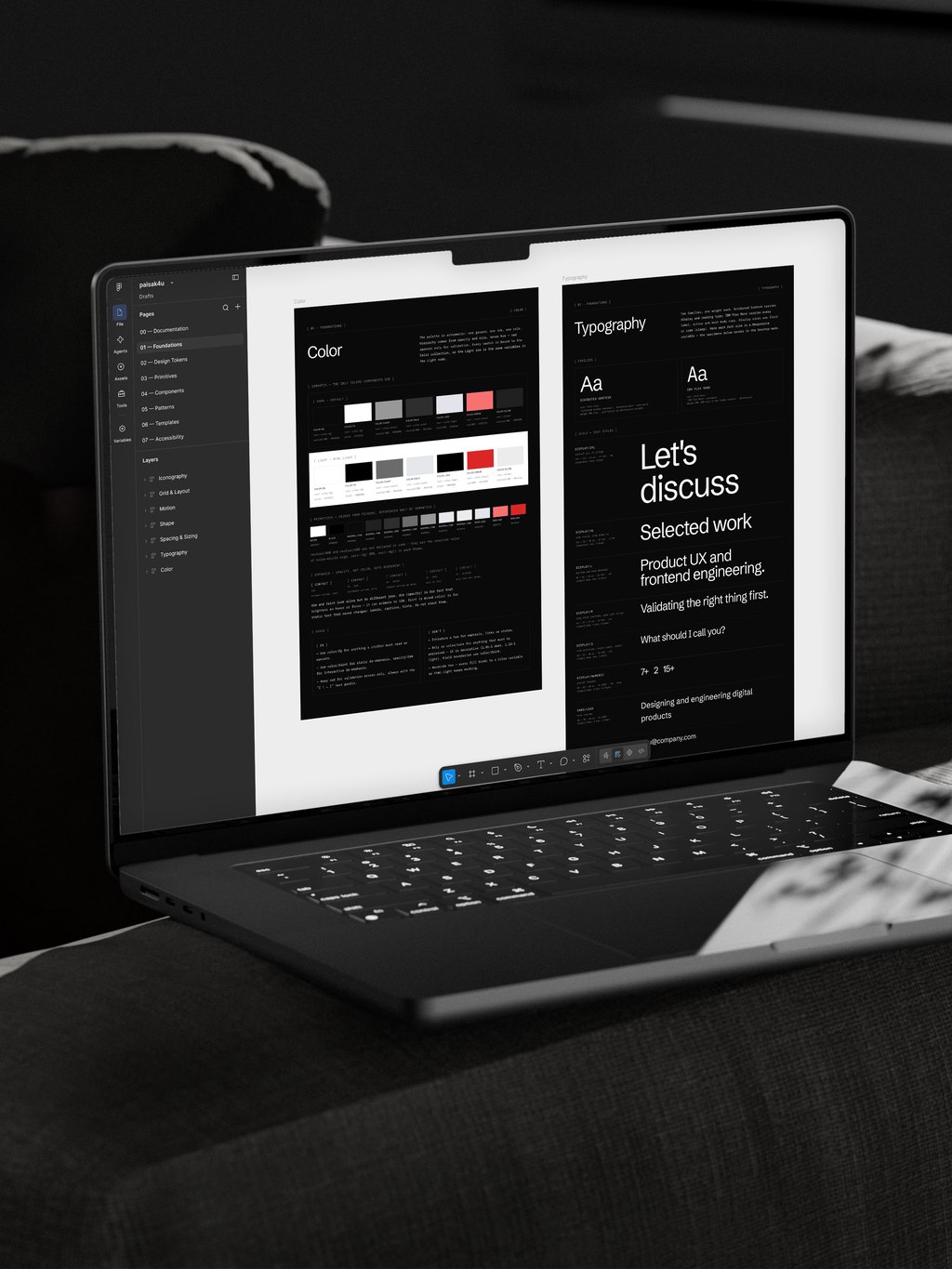
  • A laptop showing a design-system file — colour, typography and component tokens — beneath a Dieter Rams poster

    [ 02 / 04 ]

    System design

    The interaction and interface system behind the product: flows, states, components, tokens, accessibility and behaviour designed together. For AI-powered products, that also means making uncertainty, streaming, errors and model limitations visible by design.

  • A development setup — production code across a laptop and an external monitor

    [ 03 / 04 ]

    Frontend

    I build what I design. Production React and TypeScript, accessible to WCAG, tested with Jest and Playwright, and connected to the real product architecture — keeping interaction quality intact from the first frame to the shipped feature.

  • A pilot review — real-user findings and a prioritised change list on a whiteboard

    [ 04 / 04 ]

    Pilot & iterate

    A pilot with real users, not a demo. Behaviour observed, feedback and usability issues synthesised into a prioritised change list, and the highest-value improvements shipped in the next release — so iteration is driven by evidence rather than opinion.

Selected work

[ Selected work ]01 / 02
01UX engineering / AI product / Design systems · 2026 · Prototype-Built

Uxproof — engineering reliable AI experiences

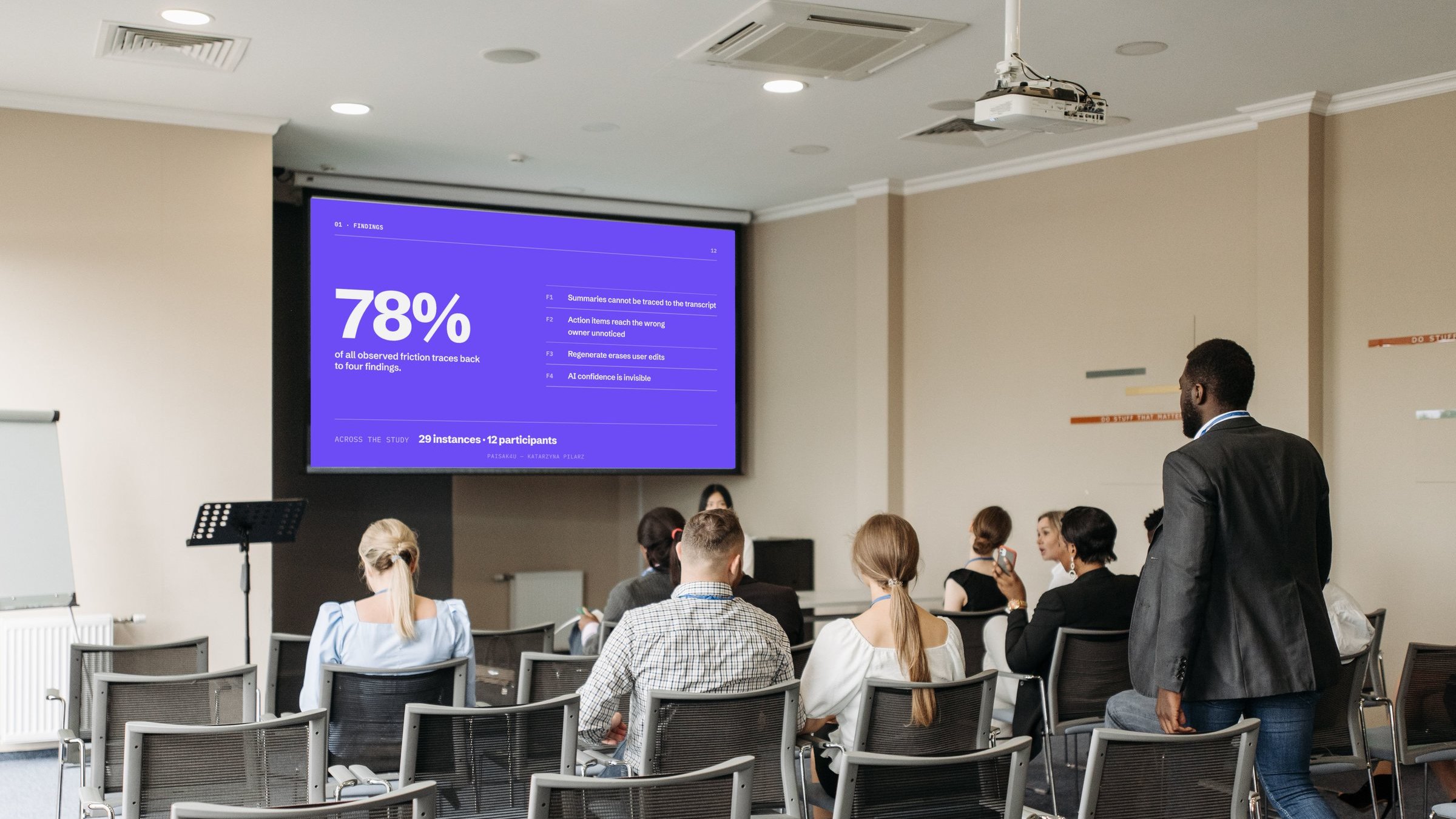
A generated uxproof deck on a meeting-room screen in front of a seated audience: the violet findings-summary slide, a large figure beside a numbered list of four findings
[ THE DELIVERABLE, IN THE ROOM IT'S BUILT FOR — THE FINDINGS POSTER, THE DECK'S ONE VIOLET STATEMENT SLIDE ]
[ Problem ]AI can accelerate complex workflows, but it also introduces unreliable states, ambiguous interactions and generated UI that can drift from the product system.
[ Approach ]I designed the interaction model and built the product in React and TypeScript, using a design system, typed contracts, accessibility rules and deterministic fallbacks to keep AI inside deliberate UX boundaries.
[ Result ]A working prototype where interaction quality is encoded into the system: reusable patterns, explicit edge states, accessible behaviour and AI output that is evaluated against the same UX rules as hand-written UI.
[ Read case ]
02UX engineering / React / Design systems · 2026 · In production

Contract obligation review

The production contract review application open on a laptop, showing the obligation queue, selected obligation with reasoning and the source contract clause
[ THE REBUILT REVIEW EXPERIENCE — OBLIGATION, EVIDENCE AND SOURCE IN ONE SCREEN ]
[ Problem ]The tool was already in production and the analysis worked. Reviewing an obligation still meant leaving the app to find the clause in the contract, with no sense of progress through the queue.
[ Approach ]I treated the analysis as fixed and rebuilt everything around it: the review workflow, the interaction model, the design system and the React frontend, behind a new API boundary.
[ Result ]A React application where the obligation, its reasoning and the source clause sit in one workspace, decisions save themselves, and scanning and detailed review share the same state.
[ My role ]Product UX and frontend, end to end — UX direction, information architecture, design system, React, accessibility and API integration. The obligation-analysis and AI logic stayed with the backend team.
[ Case study available on request ]
[ Recommendations ][ From LinkedIn ]

“Turning complex requirements into simple, intuitive user experiences.”

I had the pleasure of working closely with Kasia as part of our GenAI team at DSB, where she played an important role as our frontend developer.

Kasia has a strong eye for UI/UX and a great ability to turn ideas and sometimes quite complex requirements into simple, intuitive user experiences. We worked closely together on several parts of our GenAI platform, where she was always constructive, reliable and willing to challenge ideas when she saw a better way of doing things.

What I especially appreciated about Kasia was her collaborative mindset and the care she put into the details. She takes ownership of her work, is easy to work with, and genuinely wants to deliver something that users will enjoy using.

I would happily work with Kasia again and can strongly recommend her to any team looking for a skilled frontend developer and a great colleague. —

[ Serkan Altay · AI Architect & Lead, GenAI platforms — DSB · Aug 2026 ]
A laptop showing a GenAI job-post generator: a form for position level, output language and job details on the left, and panels of guidance on writing, reviewing and sharing the draft on the right
[ Toolkit ][ Figma to production ]

Design and frontend, by the same person.

  • [ 01 / 03 ]

    Design & research

    [ Figma · Design systems · Design tokens · Usability testing · User journeys · Information architecture · WCAG / accessibility · Data visualisation ]
  • [ 02 / 03 ]

    Frontend development

    [ React · TypeScript · Next.js · Astro · React Native · Tailwind · Zustand · Streaming UI · Framer Motion · GSAP · Jest · Playwright ]
  • [ 03 / 03 ]

    AI & process

    [ Human–AI interaction · Prompt design · Agentic workflow design · LLM application development · Claude Code · Cursor · Figma Make · Agile & Scrum · Lean Six Sigma · Jira / Confluence ]
[ Research ][ Ongoing]

How Lean Six Sigma can reduce late-stage rework in GenAI MVP delivery.

GenAI MVPs can be rebuilt multiple times — not necessarily because the technology failed, but because the wrong problem, workflow, or interaction was validated too late. Requirements shift after the demo, edge cases surface in pilot, and interface decisions are revisited in the last sprint.

This research applies Lean Six Sigma — DMAIC, value-stream mapping, defect-at-stage measurement and root-cause analysis — to GenAI delivery cycles to understand where rework originates and which early validation gates can remove it at the lowest cost.

Independent research and thesis towards Lean Six Sigma Green Belt certification, building on postgraduate AI Project Management studies completed in 2026. Findings will be published here as the work completes.

Contact

Katarzyna Pilarz
Years building digital products end-to-end
7+
Years inside DSB's GenAI team
2
Years in international, cross-functional teams
15+
Let's discuss
your project
[ BOOK A 30-MIN INTRO CALL — NO COMMITMENT ]